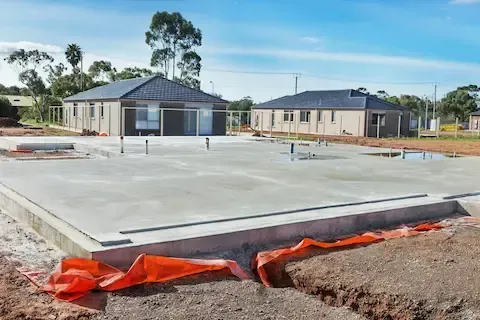
Slab Base Prep on Willamette Valley Clay Soil Lots
Clay soil is one of the most challenging substrates for concrete slab construction anywhere in the Pacific Northwest, and Willamette Valley lots near Gresham carry some of the heaviest concentrations of it. When you build a slab on native clay without proper subgrade preparation, you are not gambling with inconvenience — you are gambling with structural failure. The clay expands when wet, contracts when dry, and shifts under load in ways that poorly prepared bases cannot accommodate. Understanding what proper subgrade preparation looks like on these lots is the first step toward a slab that performs for decades rather than cracking within a few seasons.
Why Willamette Valley Clay Creates Unique Problems for Concrete Slabs
The Willamette Valley sits in a geological basin that accumulated deep layers of fine-grained sediment over thousands of years. What that means for property owners and contractors near Gresham is that the native soil is dominated by expansive clay with high plasticity, low bearing capacity, and significant shrink-swell behavior. Unlike sandy or gravelly soils that drain freely and stay relatively stable, Willamette clay holds moisture tenaciously. That moisture retention is the root cause of most slab problems in the region.
When clay absorbs water, it swells. When it dries, it contracts. A slab poured directly onto this material without modification will heave unevenly in wet winter months and settle in summer. Over a few annual cycles, differential movement opens cracks, separates control joints prematurely, and can compromise the structural integrity of anything built on top. In Gresham specifically, the combination of high annual rainfall and prolonged wet seasons accelerates this process compared to drier inland climates.
Subgrade Evaluation Before Any Work Begins
Before a single yard of material gets moved, the subgrade needs evaluation. This means more than a visual inspection. A probe or hand auger test gives you a basic read on soil composition and consistency to a meaningful depth. In many Gresham-area lots, you will find varying clay content across the same parcel — heavier concentrations in low areas, slightly better-draining material at higher elevations of the lot. Knowing where the worst material sits lets you adjust excavation depth and base spec accordingly rather than applying a one-size solution across varied conditions.
Bearing capacity matters significantly here. Native Willamette clay in its saturated state can have bearing capacity well below what a loaded slab requires. If you are building a garage slab, a shop floor, or a residential foundation slab, you need subgrade that will support both the concrete weight and operational loads without settlement. Soil testing, even a basic field test, tells you what you are actually working with rather than what you assume the ground to be.
Excavation Depth and Native Soil Treatment
Standard residential slab practice in many regions calls for four to six inches of gravel base. On Willamette Valley clay lots, that approach is often insufficient. Deeper excavation is frequently necessary to remove highly plastic clay layers and replace them with engineered fill material. Depending on conditions observed during site work, excavation depths of eight to twelve inches below finished slab grade are common in the Gresham area when dealing with saturated or highly expansive native clay.
In some cases, the native clay can be treated rather than fully replaced. Lime stabilization is one technique used to reduce plasticity and improve bearing capacity in place. However, this adds cost and complexity and requires proper curing time before base material is placed. For most residential and light commercial projects near Gresham, full replacement of the problematic clay layer with imported granular material is the more practical and reliable approach.
Gravel Base Specifications That Actually Work Here
The gravel base serves two functions: it provides a stable, load-distributing platform for the concrete, and it breaks the capillary connection between groundwater and the underside of the slab. Both functions matter on Willamette Valley lots where groundwater can be remarkably close to the surface during winter months.
Clean crushed rock or crushed gravel is the appropriate material. Well-graded crushed rock with angular faces compacts into a stable matrix and resists displacement under load. Avoid rounded river gravel for base application because the smooth particle surfaces do not interlock as effectively. A typical specification for Willamette Valley clay conditions calls for three-quarter inch minus crushed rock placed in lifts of four to six inches, with mechanical compaction between each lift. Placing all the base material at once and compacting the top surface only is a common mistake that leaves loose, uneven material beneath.
For a slab that needs to perform well long term on challenging clay soils, Concrete Slabs work begins with getting this gravel specification and placement sequence right before any formwork or reinforcement goes in.
Compaction Standards and Moisture Control During Base Work
Compaction is where many base prep efforts fall short. Mechanical compaction with a plate compactor or jumping jack compactor is non-negotiable on clay subgrades. Hand tamping is inadequate for achieving the density needed to prevent post-pour settlement. Each lift of base material should be compacted to a minimum of 95 percent of standard Proctor density — a figure your contractor should be familiar with and capable of achieving with proper equipment.
Moisture content during compaction matters just as much as the compaction force applied. Material that is too wet will not compact properly regardless of equipment effort. Material that is too dry can break down under compactor passes without achieving adequate interlock. On Gresham-area job sites during wet season, managing base material moisture is a real operational challenge. Covering placed material during rain events and allowing excess moisture to drain before compaction passes is part of doing the job correctly rather than rushing to pour.
Drainage Design as Part of the Base System
A gravel base on Willamette Valley clay cannot drain into the surrounding native soil effectively during wet periods because the clay permeability is too low. This means drainage has to move water laterally out of the base rather than relying on downward percolation. Perimeter drains, whether simple gravel-filled trenches or perforated pipe systems, are a standard component of properly engineered slab base systems in this region.
The goal is to prevent the base gravel from becoming saturated during prolonged wet seasons. A saturated base loses its load-distributing function and allows hydrostatic pressure to develop beneath the slab. Perimeter drainage intercepts water before it reaches that point. For slabs in low-lying Gresham-area lots or properties with naturally high water tables, this drainage component is not optional — it is the difference between a slab that holds up and one that requires expensive repair within a few years.
Vapor Control and Final Surface Prep Before the Pour
After compaction is complete, a layer of plastic sheeting — six to ten mil polyethylene — serves as a vapor retarder between the gravel base and the concrete. This is especially important on Willamette Valley lots because subsurface moisture migration through the base is a persistent reality. Vapor intrusion into the slab causes moisture problems in finished spaces above, contributes to adhesive failures in floor coverings, and can accelerate rebar corrosion over time.
The vapor barrier should lap at seams and seal at penetrations to be effective. Taping seams with moisture-resistant tape is good practice. Before reading our Concrete Slabs walkthrough on pour planning, make sure your base prep checklist is fully worked through — because no amount of careful concrete work above compensates for a compromised subgrade below.
Getting base prep right on Willamette Valley clay is detailed work, but it is also the single highest-leverage decision you make in the entire slab project. Every hour invested in proper excavation, material specification, compaction, and drainage returns multiples in slab longevity and performance across the wet and dry cycles the Gresham area delivers year after year.
